Finding Damo

The story of a man, his job, two cats and the meaning of success.

Archive for the category “perryperrysource”

Differentiation

I’m writing reports. I’m too tired to go and find all of the tired tropes teachers traipse out every time they talk about differentiation.

Wow, massive alliteration bomb right there.
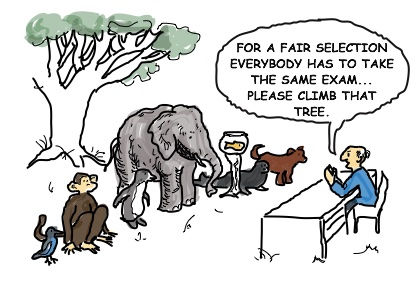
a bird, a monkey, a penguin, an elephant, a fish in a bowl, a seal and a dog in front of a man saying "For a fair selection everybody has to take the same exam... please climb that tree."

Einstein and his tree-climbing exam comes to mind immediately.

The focus for our school in the upcoming years is differentiation, and the first goal is to explore the concept and see what comes out of the dialogue. I’ll dialogue later. I’ll monologue now.

Like an evil villain. Mwahahhahahahahahaha!

See? Tired.

And I worry that, if I create a different lesson plan for each and every one of my students, and then have to mark each one differently to allow for their special abilities, that I’ll be a lot more tired later. Of course, if I spent more time marking work and less time writing blog posts, I might be less tired. But, what can you do?

Here are some thinking points:

  1. Most schools do a great deal to try and raise the grades of students on the left hand side of the bell curve.
  2. What are schools doing to extend those students at the upper end of the scale?
  3. Bored geniuses are… genii? Grant me wishes? I’ll look it up. Bored geniuses (obviously not me) are often discipline problems. They tune out because the work isn’t challenging, or isn’t relevant.
  4. Extending the high achievers definitely involves more work for teachers and will be a bone of contention in planning meetings, even if nobody says anything out loud.
  5. A lot of current educational methods are being made redundant by new technologies.

I’m not offering solutions just yet, just offering points to think about.

If you’re making students answer questions from a text book, differentiation will be difficult. Luckily, this isn’t such a prolific practice as it was when I was younger.

OK. Enough rambling. What are the solutions?

First up, look at the questions you are posing in your assignments. Are you asking students to do something that they can cut and paste from Google?

“What were some of the effects of World War 2 on the world economy?” can be typed into your favourite search engine verbatim, and students can pick and choose a variety of answers to submit as their own. There is no reason to extend myself as a student. My answers might be better than the lower kids’, but I don’t have the motivation.

Essays such as this should be put to rest. Anything that can be Googled needs to be removed from the curriculum. Try this: “Create a radio news broadcast from a specific day in 1946. Include local and world news, sports, business and weather reports”

They can Google the information but they still need to use it in an original way. You’ll have already taught them about how to be web-search literate, finding accurate and relevant information from authoritative sources. They’ll rationalise their choice of information in their updated bibliography.

They can be assessed on ICT knowledge, History knowledge, speaking and listening in English and hopefully group work.

Secondly, create tiered assignments based on your knowledge of the students. Each tier should have opportunity to stretch themselves, allowing the teacher to move them up for the next work task.

My Engineering and Design class is called The Evil League of Evil. Students start off as Minions, and work towards becoming SuperVillains. The first tasks have them following instructions and showing me that they can gather evidence. It also allows for a variety of responses, allowing those with higher skills to show this. The boys create Lego robots, designing and planning before creating, and finally evaluating their own and others’ creations.

The second task is split into three. They can Build a Robot – if they still need more help – using instructions and continuing to record evidence. They can Design a Robot – Henchman level work that gives them some autonomy but still working on a task I’ve set them. Or they can Invent a Robot – the Villain level work which lets them create a bot from scratch with no intervention from me.

From there, I can shift boys up and down the ranks, depending on how they respond to challenges. They know where they are at all times, and have the impetus to try and reach that highest level.

And of course, we finish the semester with an all in Robot Battle Royale, for those who have achieved a high enough level. Once reports are done. To keep them going for the last two weeks. There are prizes. It’s great.

I know people are thinking “But yeah, practical subjects like that lend themselves to differentiation! And think of all the extra work you just did!”

First up, I’m using Stile, which I love. It allowed me to simply copy the activities into different classes, and I could simplify the language for the minions and add a couple of bonus activities for the Villains. So, not so much extra work.
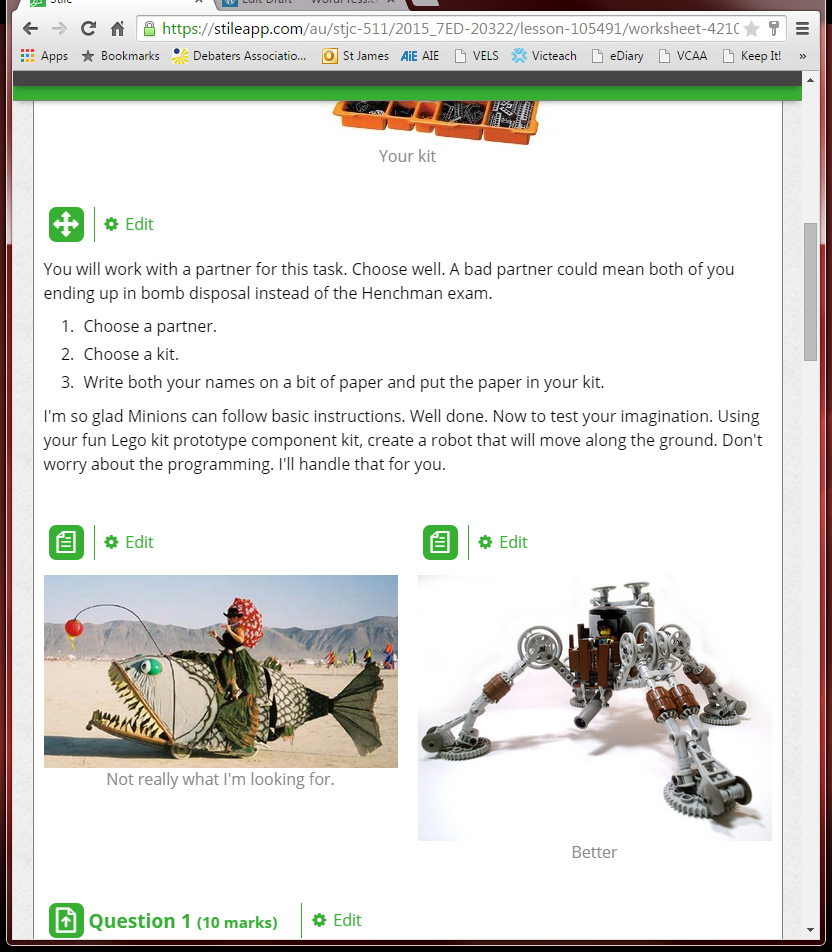
stile2
stile

Secondly… Well, sure,  you might have a point. Differentiation is easy in practical subjects. But I can come up with dozens of ways to differentiate an English or History lesson off the top of my head.

Leading to my final point in this mad ramble. One that I’m sure you’ve heard from me before: Collaboration. Nobody should have to do all of this work alone. I have a great team working with me in Technology, so assigning tasks and year levels is easy and the results are fantastic. Use your team. Have a regular spot in the morning briefing, in every staff meeting. Have one staff member share a success story in differentiation. It doesn’t have to be subject neutral. But it could give the rest of the staff that spark that lets them do the same in their classes.

I want to go into depth here. I’ve been working with differentiation for over 10 years. But I also want to keep this under 1000 words (or one picture). So I’ll stop and add more later.

Five words to go! Whoo hoo!

…Damn.

How to annoy a teacher

There are hundreds of ways to annoy a teacher. Sometimes it depends on whether the annoying person is another teacher, an administrator, a reporter, parent, relative or person on the street.

My uncles delight in telling me that I can’t complain because I have too many holidays. I could argue that until the cows come home and it wouldn’t make a difference, so I won’t bother.

I get annoyed when meetings are called (or cancelled) at the last minute. I get annoyed when I don’t see a class for three weeks due to unfortunate timing of holidays and sports days and correction days and any other multitude of days. But it’s something that happens. I’ll live.

I was unnecessarily infuriated when another teacher told me that one of the extra-curricular activities I undertake was part of my teaching loadangry teacher. OK, annoyance again was warranted but the strength of my reaction was a bit over the top.

If you’re not a teacher, or not a secondary teacher, here’s some background knowledge. Primary teachers all over the country will look at what I’m about to say and join my uncles in telling me secondary teachers are paid too much, but here goes.

We have a teaching load. Looking at my timetable I have 19 periods of teaching a week which is 15 contact hours (I think). I have five yard duties and two emergency yard duties over a fortnight. I have a couple of possible extras a week. I have time allocation for my Position of Leadership, and a couple more for IT-related work. The rest of the time we’re at work is planning, marking and other teaching miscellany. I totally admire the primary teacher who has their classes all day, except for specialist times.

We also have responsibilities. We have to show up to meetings – staff meetings, beginning and end of term training days. We have to attend some information nights and we are expected to participate in certain extra-curricular activities related to our discipline. For example, I am part of the Arts faculty, and therefore I take part in the College production. More to the point, I love the College production and therefore I take part in it (but I would be expected to do so even if I didn’t).

I teach at a smallish school. We have a dedicated staff and we’re never short-handed for any activities that are run. Because we like to get involved. Because we like to do things to enhance our students’ learning experience.

Not because we’re being paid to do it. Not because it’s part of our job description.

I’m not getting paid any more than the teacher who gets in at 9 and leaves at 3.30. This morning I started work at 6.45am and I’ll finish at around 11pm.

It’s not part of my load. And it devalues what I choose to do to say that it’s part of my job description. It took me awhile to figure out why I was so angry at the suggestion, but there it is.

This next bit will sound a bit more like a resume letter than a blog post, but I think it’s important to blow your own trumpet every now and then. Not for other teachers, who already know how much work is involved in what we do, but for my uncles.

Here’s the short list of my extra-curricular involvement at the school:

  • Debating coach (five evenings, plus finals, plus lunchtime planning sessions, plus research and planning, plus professional development and the associated catchup)
  • Creative writing club (lunchtime meetings, plus excursions, plus research into competitions and publishing opportunities, plus proofreading and lesson plans – purely for the boys’ enjoyment and not part of school, plus Write-a-book-in-a-day (8am-8pm))
  • College radio before school at the community radio station (getting up before 6 for a 7-8am show, once every three weeks)
  • College production (don’t even ask, especially on years where I have a more active role)

Not paid for any of it. And apart from the College Production, not even expected to do any of it.

And I really don’t care. I love doing it all. I love being a part of these activities and I don’t begrudge the time spent making them work well (although my wife might sometimes).

But I want to be a bit selfish. I want people to look at what I’ve done and say “look at what he’s done for these kids – that’s pretty special” rather than “meh. It’s part of his job.”

OK, rant over. I just wanted to work my way through an extreme reaction to a simple comment.

my jobAnd now, back to work. Playing with Lego, making movies, creating robotic animations, printing out 3D Pokéballs and taking photos.

My life is soooo hard.

Technology and Distractability

I’m writing this at parent teacher interviews. As an IT teacher, I’m not in as high demand as the English and homeroom teachers. Most of the students in my class are there because they want to be. So I have time.

I can mark work, prepare lessons and write articles.

When I do manage to talk to a parent, sometimes they’ll find out that I had a lot to do with implementing the iPad program at the school and invariably I’ll get the comment: “How do I stop him from wasting time on the iPad?”

There are a few options here, depending on how diplomatic I’m feeling. For the most part, these work both in the classroom and at home.

1. Not at all diplomatic: You’re the parent. You rule the roost. Put some rules in place that mean that he doesn’t do things he’s not meant to do.

2. Slightly more diplomatic: Have a conversation with your wayward child. What are they using the iPad for? How important are the various different activities? How much time does he realistically need to properly stay in touch with friends and have some leisure time? And then come up with a mutually negotiated timetable for class use versus leisure use. And of course, if the timetable isn’t upheld, you stop being diplomatic and go back to step 1.

all the wonderful things an iPad can do.

3. Very diplomatic: If the work your son is required to do on his iPad isn’t challenging enough or hasn’t been explained properly, then a confused student is a student who ends up on social media. Tablets are incredibly powerful machines. With the proper motivation, students could be inspired to create a movie, make an interactive app or design a scavenger hunt. With no motivation, they can Google the answer, copy and paste work into a Keynote and hand in a Pages document called Blank 43 (which is probably very accurate).

The reality is somewhere between all of that. You are the parents, and you do have the ability to place restrictions on your child’s use of technology at home. The teachers at school are in a similar situation. Any restrictions placed on a student should be made in conjunction with the student, to limit the amount of resentment and rebellion involved.

Your job as parents is to be aware of what your child is meant to be doing and what they’re actually doing and modify the ratio between the two so that the work gets done.

Our job as teachers is to make sure that the work that they do on their tablet is valuable and stimulating and not just busy work that we don’t want to mark as much as they don’t want to do it.

Sorry, did that answer the question?

Parents and Social Media

This post comes out of a conversation I had on Twitter. I made the comment that parents need to have Social media accounts so that they can have a meaningful dialogue with their children. The quote I stole from the presenter I was listening to was “You wouldn’t take your kid swimming if you couldn’t swim.”
I thought it would be just one more tweet in the Twittersphere – ignored and moving on. But it gained a bit of attention, and started a lively discussion.
I’m going to paste the conversation here, because Twitter is a hard place to have a good conversation. Feel free to weigh in. I’m also going to post it, and then edit it when I get to a proper computer, so that I can add in some pictures and links to yesterday’s presentation from the AP at Kilbreda.

Here goes, in some vague order but with no guarantees:
Dan: what! Thats not true surely…I cant swim but take my kids to swimming lessons …
Fiona: But are you the one teaching them to swim? 🙂
Dan: no of course not …. but will get in the water with them… I am an esafety advisor btw for ceop and afp

Emma: No you dont. Dont need to be a swimmer to teach swimming. Dont need a SN account to understand SN
Emma: dont agree you need SN account to protect kids. You need to supervise your kids’ account #havetheirpassword
Fiona: Spying on them? No thanks.
Emma: it’s called parenting.
Emma: How else would you recommend parents see what their kids are doing online?
Dan: hiya, not sure what you mean ..how do they see?
Emma: suggested having passwords was “spying” on kids. Wondered how she suggests knowing what kids are doing
Fiona: just developing an open, honest relationship with them
Emma: That is definitely important, but also not enough. Abuse is not always because they did something wrong. More often because someone else did. Keeping tabs on their account aids watching other people. dealt with so many abused kids whose parents thought they had good open honest relationship

Dan: not all teachets on twitter or social net… thats also an issue
Emma: Why do they need to be on twitter. What if their kids are on Whatsapp or Snapchat? Do they have to create?
Dan: I agree.

Dan: I put a free site together http://t.co/yUtnJLB96Y and its got a parenting section
Dan: Why do they need to be on twitter. What if their kids are on Whatsapp or Snapchat? Do they have to create?
Dan: having done loads of presos to parents in uk and aus ..same issues everywhere for them.
Emma: Yep. Usually the knowledge gap between the two and a fear or lack of motivation by parents to close it

Dan: I agree but parenting is complex… lots of analogies. . Analogies are mostly stupid. Need to focus on the issues.
Dan: fr example do you need to be a football player to coach football
Damian: you need to have played football to coach it ^properly^… Surely
Emma: No, you need to understand the sport I have seen coaches who have clearly never kicked a ball in their life

Emma: I have never used snapchat or Instagram, but am well versed in problems therein and what parents can do.
Dan: absolutely I use most but but not all of them


Ok, that’s the conversation so far. Excuse spelling and grammar errors. I’ve just copied and pasted directly from the Twitter feed.

There is a lot more in this, but not during keynotes. I’ll write more about it tomorrow.

Two final tweets from me:
I can’t talk to my students about Scrillex. I haven’t listened to it. Likewise I need some experience with SM to have a dialogue.

Parents who make decisions about their child’s SM use w/out experience can make judgements based in fear rather than knowledge. #DLTV2014

Post Navigation